Curious about what all creatures great, small and microscopic are getting up to? These two far-ranging and eye-opening books take an in-depth, often irreverent look at animal sex and reproduction with an eye toward evolution, biodiversity and the vitality of life on Earth.
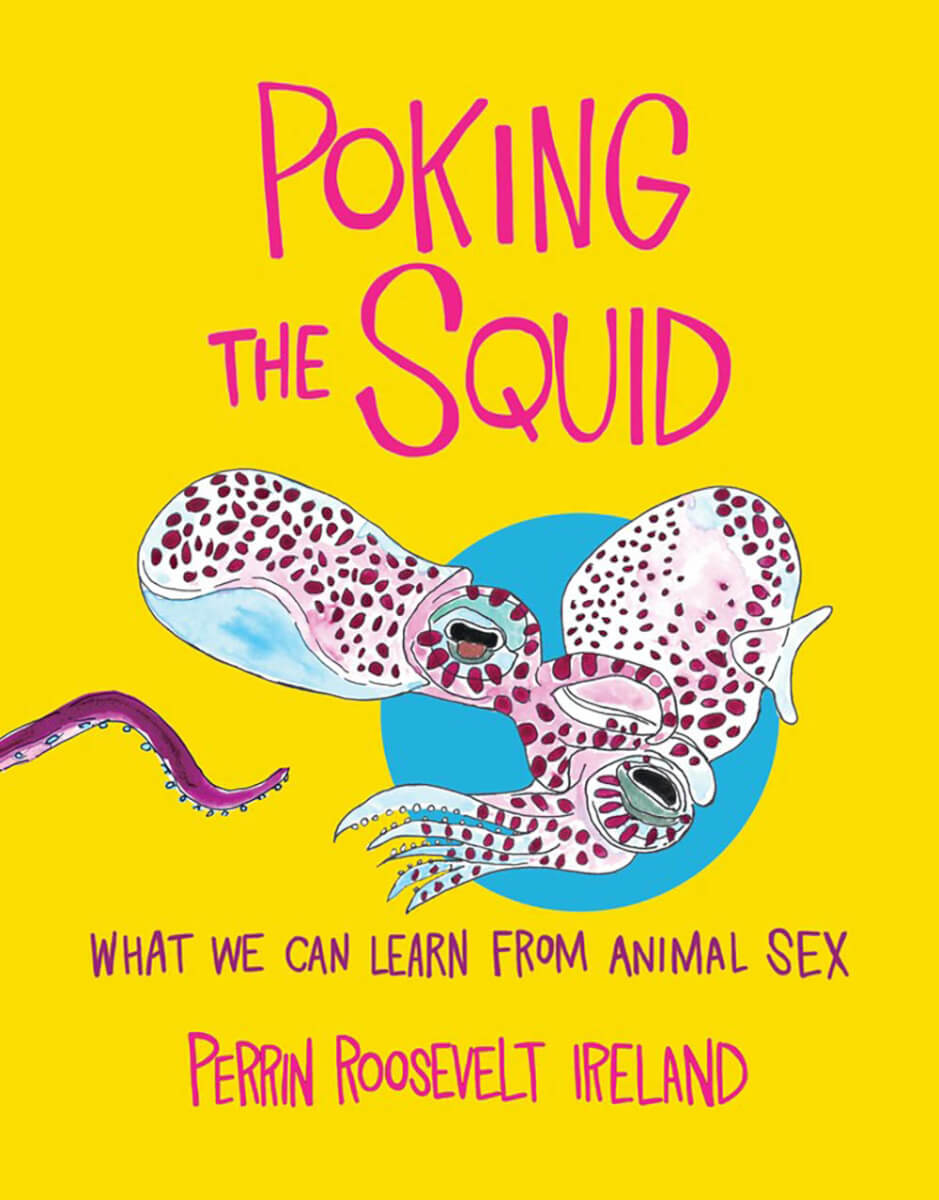
★ Poking the Squid
Fans of Perrin Roosevelt Ireland’s “Thirsty Science” short-form video series (on Instagram and her website since 2021) are already familiar with her signature blend of information and irreverence: She holds forth on the latest research into everything from cockroach reproduction to dolphin clitorises while implacably—and impressively—hula-hooping.
Now, she’s debuting Poking the Squid: What We Can Learn From Animal Sex, a superbly illustrated work of graphic nonfiction jam-packed with intriguing animal facts, expertly rendered visual and textual humor, and heartfelt advocacy for embracing new perspectives on the creatures who share our planet.
As in her videos, the artist and environmentalist (she worked for the Natural Resources Defense Council, was artist-in-residence at the New York Aquarium and is a great-granddaughter of Franklin and Eleanor Roosevelt) addresses the viewer/reader directly while her cats Ursula and Pudge provide an assist. Other animals speak up, too: Prairie voles remark that “Sex helps us bond faster, activating our reward center” while acorn barnacles quip about their penis length, which varies depending on the choppiness of the waters they live in. (One is cemented in a calm spot, “so I grow a long love wand and control it with ease.”) An astonishing range of critters is featured in Poking the Squid; the extensive Index of Animals at book’s end will help readers find their favorites, from black vultures to elephants to three-spined sticklebacks and more.
Through it all, Ireland offers her own takes on the wildly varied marvels of animal cohabitation, copulation, parenthood, sexual biodiversity and family structures while sharing the work of 50-plus scientists she interviewed for the book. She addresses the notion of animal pleasure (previously ignored or denied, more recently studied and acknowledged) and attendant concerns about consent in lab or breeding scenarios. She also points out that “seeing sexual diversity as a form of biodiversity might better enable some of us humans to use the erotic to understand our differences as well—via pleasure!”
Every page of Poking the Squid bears fascinating information and gorgeous, often hilarious, watercolor comics that impart wisdom, boost empathy and induce awe all at once. And just in time, too: As Ireland notes, “Savoring Earth’s eroticism is a resilience tool for incessantly trying times.”
On the Origin of Sex
In his introduction to On the Origin of Sex: The Weird and Wonderful Science of Reproduction, author Lixing Sun promises a “tour [of] some of the strangest, most enthralling wonders the natural world presents.”
The distinguished research professor at Central Washington University and author of The Liars of Nature and the Nature of Liars: Cheating and Deception in the Living World certainly delivers. His talent for translating decades of complex research into accessible explanations for the curious layperson makes for an enlightening, engaging read that raises intriguing questions ranging from “Where did sex come from in the first place?” to “Are yeasts sexual or asexual?”
The answer to the latter is “They’re both . . . and alternate between the two in their life cycle.” Other “reproductive flip-floppers” include strawberries, flatworms and the whiptail lizard, which “has almost perfected the switch from a wild night out to, well, cloning itself at home.” As for the former query, Sun leads readers back two billion years to when asexual reproduction reigned supreme. It was, and continues to be, an efficient means of replication—“the genetic fast lane.” But if a mutation occurs, its replication can lead to the demise of a species.
Sexual reproduction, Sun explains, mitigates DNA damage and creates gene diversity that encourages adaptation and boosts survival. There are myriad, wondrous variations in the ways in which species reproduce; similarly, gender in the animal kingdom is far from static or binary. Rather, the gender flexibility found in nature is a “shape-shifting, ever-evolving state” that helps animals “[respond] to whatever curveballs their environment throws at them.” Clown fish and swamp eels are two species that can “enjoy the perks of both worlds.”
Readers who enjoy having their minds boggled by fascinating revelations about the creatures with which we share the Earth—bears, condors, platypuses, mushrooms, microscopic eukaryotes and more—will be delighted by On the Origin of Sex. Copious conversationally written footnotes plus a glossary will aid readers in more fully understanding Sun’s sweeping, celebratory investigation of “one of the most puzzling, persistent mysteries in all of biology.”