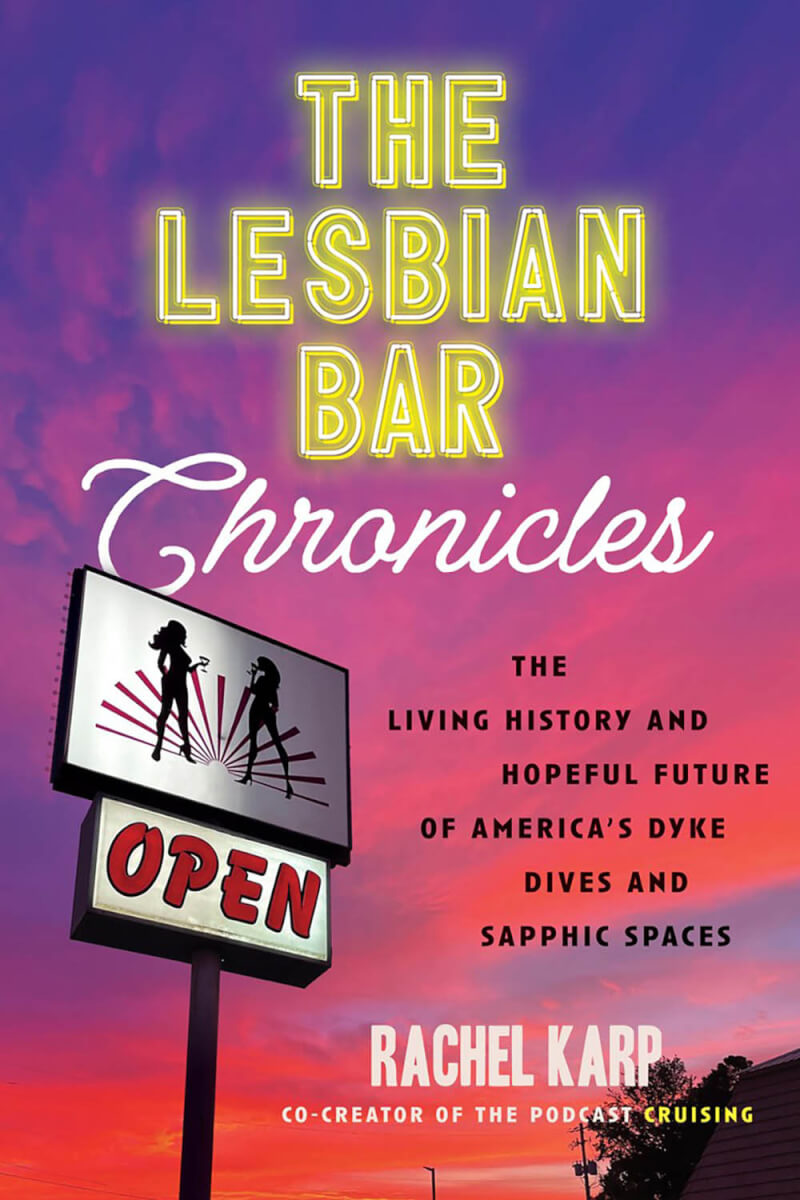
In 2020 and 2021, news articles speculated that the few dozen remaining lesbian bars in the U.S. might soon be gone. This concerned Rachel Karp, who had made memories in several of these bars and recognized them as repositories of queer knowledge and records of queer lives. As she puts it, “For centuries, queerness was often a secret taken to the grave. This is why so much of queer history is found not in books, but in bars.” Together with her girlfriend, Jen McGinity (now her wife), and her friend Sarah Gabrielli, Karp decided to take a road trip to visit lesbian bars across the country, seeking out the stories of their owners, employees and patrons. They shared their findings on a podcast, “Cruising,” that the three co-produced.
In The Lesbian Bar Chronicles: The Living History and Hopeful Future of America’s Dyke Dives and Sapphic Spaces, Karp recounts what they discovered at each of the 20 bars they stopped at, and adds chapters about lesbian bars that no longer exist, but that have left major legacies. These historical chapters are some of the most moving and interesting in the book. One illuminates a Prohibition-era lesbian tearoom run by Eve Adams, a leftist who also worked for Emma Goldman’s Mother Earth. Another captures Chicago’s lesbian nightlife scene from the ’60s to the 2000s, including a party for women of color called Executive Sweet. When booking venues, organizers Patricia McCombs and Vera Washington would tell bar owners that they were planning a sorority meeting.
Karp also documents the “Cruising” team’s visits to recent additions to the sapphic sphere, like The Bush in Brooklyn, New York, and the Sports Bra in Portland, Oregon. Some of the bars face neighborhood opposition, like Washington D.C.’s As You Are. Others are the subjects of controversy after they’re revealed to have safety issues or mistreat their employees. Reactions will vary to the testimonies of those involved in these incidents, some of which are upsetting. Through all these accounts, however, what stands out is the variety among modern queer spaces and the people who make use of them.
Because everyone’s experiences of sexuality and gender are unique and are only a fraction of what makes us who we are, there’s no generalization about queer people that doesn’t crumble to pieces under examination. But in one of our bars, we can bump elbows and buy each other drinks, taking part in rituals we’ve engaged in for at least a century, if you count from Eve Adams’ tearoom. Judging from the new lesbian bars that have opened since Karp wrote The Lesbian Bar Chronicles—like Nashville, Tennessee’s Chapstick—rather than being consigned to history, lesbian spaces are lighting up our future.