It was 1976, and as I drove through Marin County, north of San Francisco, an enormous building emerged from the distant hills. It seemed almost otherworldly, as if a spacecraft had landed in a field and burrowed its way into the ground.
Article continues after advertisement
It was the Marin County Civic Center, designed by Frank Lloyd Wright.
I was captivated by this strange, futuristic building. Its muted pink structure and long, low profile extended into the valley, while its circular and semicircular openings were classical and serene. The building seemed to belong to the landscape even as it challenged it.
I didn’t have the vocabulary then to explain what I was experiencing. I only knew that a structure had altered my perception of the world around it.
Years later, I understood that my draw towards architecture was the relationship between structure and experience. How does a room hold memory? How does a building establish a sense of place? What happens to a structure when people inhabit it, when their histories become entangled with its own?
These questions are not so different from those a writer might ask. A novel, like a building, has a framework (beginning, middle, and end) that holds its parts together: passages that lead us from one place to another, openings that illuminate or obscure a path. Within this framework, writers use language and syntax as an architect uses a straight-edge and pencil. But the most compelling buildings, like the most compelling stories, are more than the sum of their parts. Something happens when human experience enters the structure of both: they’re altered by memory and imagination, capable of holding meanings its creator may never have intended.
When I write, I return to a handful of books that have helped me think about the connections between writing and architecture. Each offers a way of thinking about the relationship between the structures we create and the lives we live within them. And each, in its own way, has something to tell us about storytelling.
*
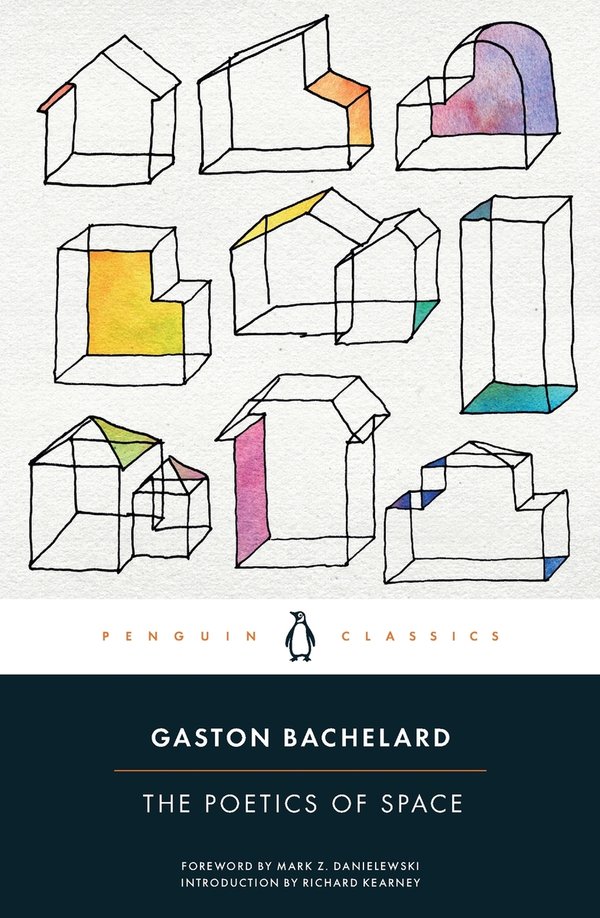
Gaston Bachelard, The Poetics of Space
A paperback copy of this book was given to me in 1975 by an architect friend. I read it cover to cover and still have that same dog-eared copy, its spine broken, its loose pages held together with tape.
It opened a door for me.
Bachelard writes about the house as a place of reverie and memory. The attic, cellar, drawer, corner, nest—these ordinary spaces become charged with our inner lives. The house is not simply a structure that protects us; it becomes a structure within us.
For writers, Bachelard offers something essential: the understanding that place is never merely a physical backdrop. Rooms can carry emotional history that a character cannot always articulate. The smallest physical detail can be a portal into memory. And often a place we have left behind continues to inhabit us more powerfully than the place in which we presently live.
Bachelard gave me permission to think about architecture lyrically, just as one may think about a poem or prose: the words and the images free our minds up to fall beneath the surface, to tune into the cadence of the subconscious.
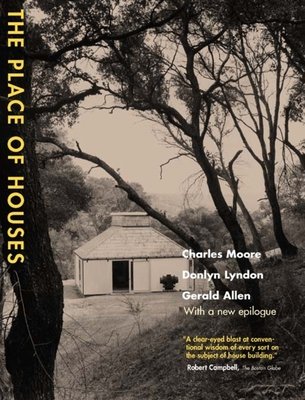
Charles Moore, Gerald Allen, and Donlyn Lyndon, The Place of Houses
The premise of The Place of Houses is deceptively simple: to look closely at the ordinary things that make a house feel uniquely one’s own, while understanding the house within the larger context of its community and landscape. A house should not simply look good from the outside. It should feel good to inhabit.
Something similar happens in fiction. A writer imagines not only the world in which a story takes place, but how a character moves through that world. Where does she feel safe, protected, exposed? What does she see from her window? Which room does she avoid? What does she carry from one place to another?
The relationship between inside and outside is especially compelling. A threshold is never simply a doorway. It marks a passage between different kinds of experience, between the intimacy of the private world and the uncertainty of what lies beyond it.
One of the authors, Donlyn Lyndon, once spoke to me about the importance of establishing a sense of place, of allowing the landscape to suggest the patterns from which the building emerges. I remember the conversation about the wild, unprotected outdoors and the shelter of the interior. Neither could be fully understood without the other; in that understanding, he said, lies the balance between outdoors and indoors.
A story, too, establishes its own geography, of both exposure and refuge. The places characters inhabit can reveal the tensions between their inner and outer lives, often more eloquently than anything they say.

Christopher Alexander, A Pattern Language
Christopher Alexander’sA Pattern Language proposes that the places in which we feel most comfortable and alive share recurring patterns. These patterns exist at every scale, from the arrangement of a town to the placement of a window seat. They’re not matters of style or taste: they reflect something elemental about the ways human beings seek comfort, connection, privacy, and belonging. Like spoken and written language, which is made up of simple and complex sentence structures, Alexander’s pattern language offers a vocabulary from which an almost infinite number of combinations can emerge.
Writers also draw upon patterns that give a story its coherence. The intimate language between lovers and friends is different from the language used in public. A gesture repeated at different moments. An object that acquires new meaning each time it appears. A place to which a character returns, changed by what has happened in the intervening years.
Like the patterns Alexander describes, these elements can be deceptively simple. Their power comes from their relationships to one another; from the way they accumulate meaning.
There is something reassuring in Alexander’s belief that places of great beauty and humanity can emerge from patterns of experience accumulated over time. No single element needs to carry the entire weight of the design. The same is true of a novel. Its meaning often resides not in a single dramatic revelation, but in the quiet recurrence of images, gestures, and experiences that gradually form the world of a story.
Christopher Alexander, A Timeless Way of Building
In A Timeless Way of Being, Alexander attempts to name something that is, by its nature, difficult to articulate– “a quality without a name,” or, the quality that makes a place feel alive. It is not style or fashion, nor is it conventionally beautiful. Alexander speaks of a quality that has fire, something connected to nature, to wholeness, and to impermanence. There is a similar quality in literature. There are novels whose structures are well plotted, whose sentences are beautifully wrought, and yet something essential remains absent. And there are others, perhaps less formally perfect, that seem to breathe. Their characters live in our imaginations long after we’ve closed the book.
What gives a work that mysterious vitality?
Alexander suggests that a building acquires its deepest integrity when it emerges from a process attentive to its surroundings, materials, history, and the people who have or will inhabit it. Rather than imposing a predetermined form, the architect must learn to recognize what the place itself is asking for.
In writing, we begin with an idea, perhaps even a carefully imagined structure, but at some point, the work makes demands of its own. Characters can resist, making it essential to shift the original idea. There is surrender involved, a willingness to relinquish control and trust what is emerging. The writer, like the architect, must learn when to impose a structure and when to listen if they are to write something with that “quality without a name.”
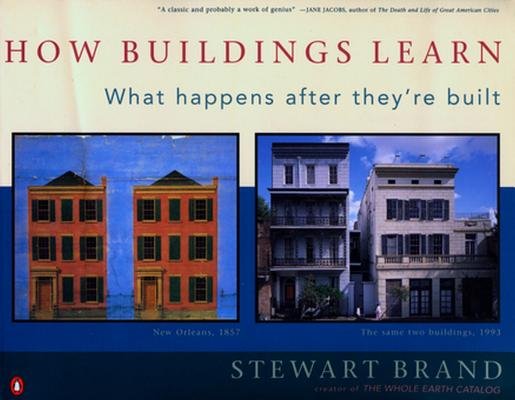
Stewart Brand, How Buildings Learn
Stewart Brand begins with a simple but radical idea: a building is never finished.
We tend to think of architecture as something completed at a particular moment, when the scaffolding comes down, the architect leaves, and the occupants move in. Brand asks us to think of buildings not as static objects but as evolving structures, shaped by the passage of time and the changing needs of their inhabitants.
I find the idea both practical and poetic.
We often think of a story as something that moves from a beginning toward an end, where all the loose ends are neatly tied up. Life rarely works that way, and the lives within a story are never truly finished. Each has a life that preceded the first page and a future that extends beyond the last. What the writer chooses to include or leave out is all part of the craft of storytelling.
Brand’s book suggests that endurance depends not on resisting change, but on making room for it. This is a particularly rich idea for fiction, where the past is never entirely past, and where transformation rarely means beginning again from nothing.
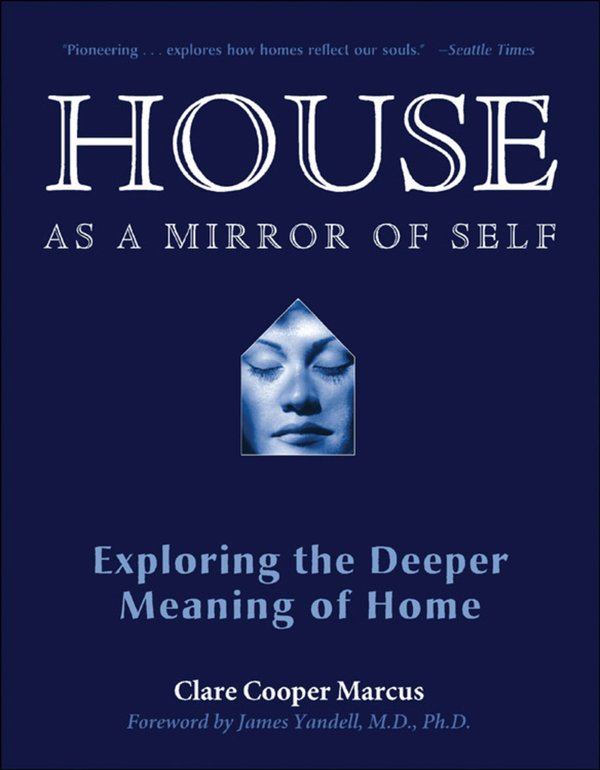
Clare Cooper Marcus, House as a Mirror of Self
Clare Cooper Marcus takes the idea of the house as a container for memory and extends it into psychology. Drawing on Jungian thought and interviews with people about their homes, she explores the possibility that the places we create around ourselves are, in some ways, unconscious portraits of who we are.
For a writer, this is an especially fertile idea. A character’s home can reveal the space between who she believes herself to be and who she actually is. A carefully ordered room may conceal a chaotic inner life. An inherited piece of furniture may carry the weight of an unresolved relationship. A house filled with beautiful things may be a place of profound loneliness. The physical environment becomes a form of characterization, an outward expression of an interior life. And how much of what we build around ourselves is an attempt to recover something lost? How much is an effort to become someone new? Marcus reminds us that the places we inhabit are never psychologically neutral. They are active players in the stories we tell about ourselves, and sometimes they reveal the stories we would rather not tell.

Ada Louise Huxtable, On Architecture: Collected Reflections on a Century of Change
Ada Louise Huxtable was a critic—sharp, exacting, and often unsparing—but beneath her judgments was a deep belief in the responsibility of architecture to human beings. She understood that buildings are not simply aesthetic objects. They shape the lives of the people who encounter them, sometimes in ways that are barely perceptible. They influence how we move through cities, how we experience public space, how we understand our place in a community. What I admire about her is her insistence that architecture matters beyond the intentions of its creators. A building exists in the world. It has consequences. It can enlarge our sense of possibility or diminish it. It can offer dignity, beauty, and belonging, or it can disregard the people it is meant to serve.
There is a corresponding responsibility in storytelling. A writer creates a world and invites readers to inhabit that world. The choices a writer makes—whose lives are represented, whose experiences are overlooked, what is revealed and what remains hidden—shape the reader’s encounter with that world and their experience of it. Huxtable’s criticism reminds me that form and beauty are not ends in themselves. A beautifully designed building that doesn’t serve the people who live and work within it, fundamentally doesn’t serve architecture. A story, however purposefully crafted, must also serve the reader beyond just telling a story. Its larger purpose is to lead the reader back into the self, to ignite a resonance of heart and mind.
______________________________

Restoration by Carol Davis is available from Rise Books.