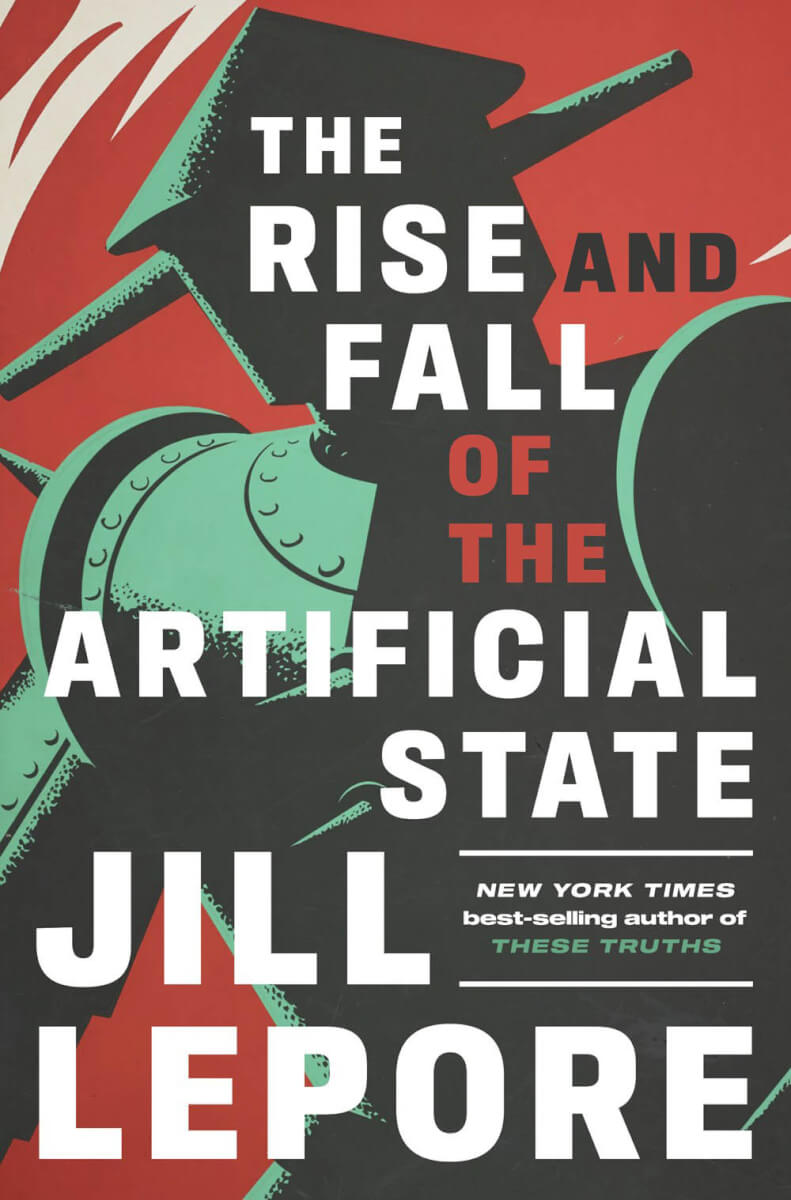
In her thoughtful and deeply unsettling The Rise and Fall of the Artificial State, Pulitzer Prize-winning Harvard historian and New Yorker staff writer Jill Lepore (We the People) examines our headlong race toward a technology-driven form of governance that she argues is rapidly supplanting liberal democracy, and that may, in its full flowering, deprive us of our very humanity.
Inspired by Hannah Arendt’s 1958 The Human Condition and by the emergence of ChatGPT in 2022, Lepore sets out to examine what she calls the Artificial State, a governing philosophy that is, at its heart, a “fantasy about humans, machines, and the earth. . . . The Artificial State is less a state than a dream of being without one, the dream of the severing of humans not only from the natural world but also from one another, every umbilical cord cut.” Her book is an ambitious but concise survey of the historical roots of that idea, contrasting various utopian visions of technology’s benevolence with the reality of its documented malign effects on the political process.
Lepore is especially pointed in her criticism of prominent “merchant princes” of Silicon Valley like Elon Musk, Peter Thiel, Mark Zuckerberg and others. While acknowledging their exceptional talent for creating unimaginable personal wealth, Lepore contends that these “techno-libertarians” have demonstrated little concern for the well-being of the society that has enabled them to amass those fortunes. Instead, she notes, they’re focused on forging interplanetary and other exotic escapes from a planet dying at their hands.
In the book’s second half, Lepore views these developments through the lens of science fiction, a genre she says is “crucial both to understanding the rise of the Artificial State and to anticipating its fall.” Among other things, she offers a wide-ranging investigation of works from writers like Isaac Asimov and Douglas Adams that conceptualize a future shaped by artificial intelligence, while considering humanity’s posture in relation to other species and the natural world. Lepore is less fearful of superintelligent robots dominating humans than she is of the destruction of our planet, which, she writes, is likely to occur long before technology can reach that point.
Lepore concludes with the hope that the Artificial State “can be dismantled” through the established tools of liberal democracy, like free and fair elections. It’s a tantalizing prospect, yet after reading her assessment of our current state and the forces at work within it, it seems reasonable to wonder whether a benumbed citizenry will muster the will to use them.