★ My Inner Child Wants to Kill
A few months back, I had the double pleasure of reading Karsten Dusse’s Murder Mindfully while concurrently bingeing Netflix’s TV series based on the book. Both were comically macabre, and I am happy to report that the follow-up, My Inner Child Wants to Kill, also translated by Florian Duijsens, equals or exceeds its predecessor. Case in point, the opening page: “As the massive Russian climbed into the trunk of his own car, he looked almost like a scared little boy. ‘And I’ll see Dragan soon?’ Boris asked me. ‘You’ll see Dragan soon,‘ I reassured him. . . . I felt content. Even though I’d lied: Boris would never see Dragan again, at least not in this life. Dragan had been dead for a week.” The lead character and narrator, shady lawyer Björn Diemel, is harried both at work and at home. He finds some dubious solace in murdering people who, in his estimation, need to be murdered. Thanks to his ongoing sessions with a mindfulness counselor, he has learned to commit these murders, um, mindfully, although not without a certain amount of residual guilt. In point of fact, he’d kinda like to stop, but there are the pesky matters of the prisoner in his basement and the blackmailer who appears to know a bit too much for Björn’s own good. In the midst of all the mayhem and hilarity are moments of true insight for Björn and the reader regarding the effects of the “inner child” on adult actions, like mindful murder for example. Season two will be worth the wait.
The Night Hunter
Natalie Moss’ The Night Hunter neatly splits the difference between a psychological thriller and Survivor as a pair of somewhat estranged sisters venture deep into the South African bush, entourage in tow, to fulfill the enigmatic dying wish of their mother. It does not take long for the trip to go seriously pear-shaped. Their safari vehicle crashes on a remote washboard road, leaving them to navigate the bush on foot, and then their guide turns up dead at the hands of a person or persons unknown. One member of the entourage had joined the group uninvited, so naturally he is the odd man out, the one suspected of being behind whatever misdeeds transpire, but the truth is murkier than just that. Each member is hiding a dark secret or two from the others, and nobody quite knows which one or ones they can fully trust. Along their journey, they discover that they are being stalked by at least three different potential predators: two of them human and one in the “to be disclosed” column, perhaps an opportunistic leopard. Under cover of darkness and/or vegetation, they make their way toward their destination, but their progress is impeded by a destroyed bridge, a strong current and the aforementioned potential predators. Moss’ characters are well drawn, often relatable; however, some of them, as is the case in Survivor, are gonna get voted off the island—and lethally so. The African bush is unforgiving, and relatability carries no currency in that milieu.
Shrink Solves Murder
The “rollicking good fun” category this month is filled by Philippa Perry’s Shrink Solves Murder. The protagonist, Patricia Phillips, is a curmudgeonly retired London psychoanalyst now residing in the seaside resort town of Beachy Head, where she terrorizes all the local scofflaws who commit such heinous crimes as littering or neglecting to clean up after their dogs. She is quite dismayed to discover that a dead body at the foot of the Beachy Head cliffs is none other than that of her 3 o’clock client, who was a no-show that afternoon. The police rule it a suicide, as the location has quite the reputation as a “topping oneself” spot. But Patricia had spotted no signs of depression in her client, so she decides to set out to prove the constabulary wrong, aided in that endeavor by her friend Prichard Knowles, known far and wide for his homemade and quite undrinkable alcoholic libations. As the story progresses, Patricia becomes more and more frustrated by the lack of interest from the police and recruits some local talent to provide assistance. The characters are all delightfully quirky, and the cast of suspects is appropriately diabolical, while remaining firmly appropriate for the “cozy-adjacent” vibe of the book. It’s an altogether entertaining read.
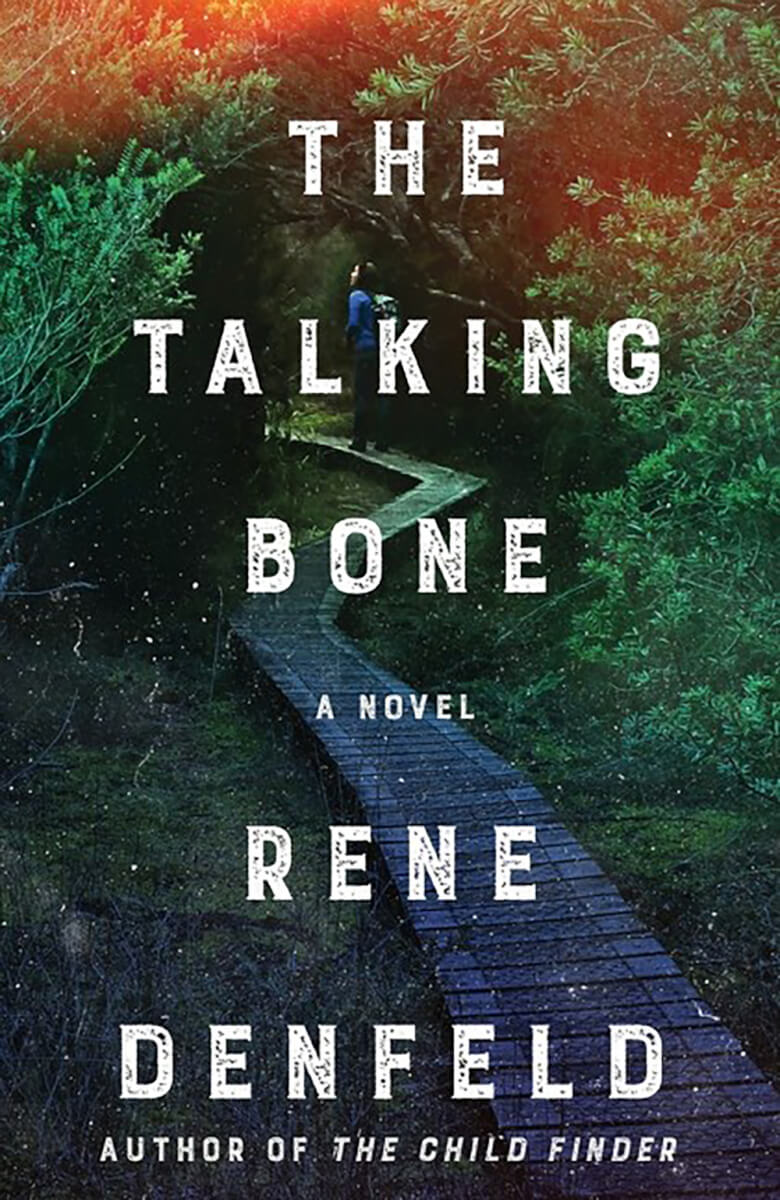
★ The Talking Bone
Georgia PI Ruby Spencer is not your run-of-the-mill private investigator; her practice focuses on saving innocent death row inmates from execution. She is so good at this that she has earned the nickname “The Exonerator.” In Rene Denfield’s latest mystery, The Talking Bone, Ruby takes on a dire, seemingly hopeless case. Mitchell Brown has steadfastly maintained his innocence. The evidence against him is pretty strong, though, anchored by a confession he now says was coerced. Worse yet, his execution date is approaching rapidly. Ruby learns that Brown’s mother disappeared when he was young, a startlingly similar disappearance to that of her own mother many years ago, and in the same area of Oregon. Her interest piqued, she accepts the case, knowing that the chances of changing the outcome lie somewhere between slim and none. As the investigation proceeds, Ruby crafts a map of similar disappearances, with pushpins marking the locations, and a disturbing pattern begins to emerge. It is always something of a fine line to review a mystery novel without giving away any of the secret, so I will diverge from that path and simply say that the ending is not only unexpected, but truly shocking.