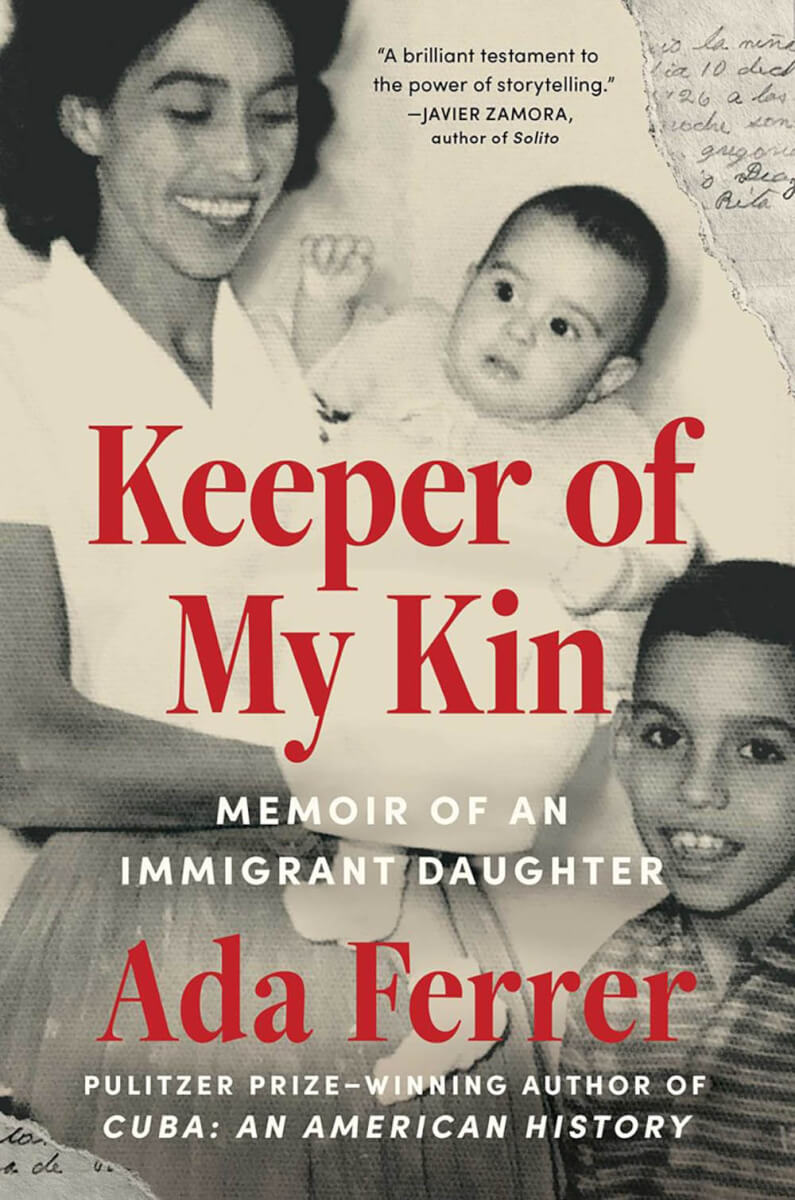
Some memoirs swagger with the author’s self-importance. Not historian Ada Ferrer’s magnificent, aptly titled Keeper of My Kin: Memoir of an Immigrant Daughter. Ferrer, a habitué of musty, fragile archives and a brilliant writer, won a 2022 Pulitzer Prize for Cuba: An American History. In this memoir, she writes “as the strange daughter who loves to document her parents’ memories.” The story she tells is “a chronicle of a family broken by history and made by it, too.”
In April 1963, shortly after the Cuban missile crisis, Ferrer left Cuba at 10 months old in the arms of her mother. Her father, an anti-communist, had been in the U.S. for several years, working as a punch press operator in Brooklyn, New York. At the time, most people thought the Castro regime would soon fall. But Ferrar’s mother didn’t want to wait; she was deeply in love, and even a relatively short separation from her husband was intolerable. Ferrar’s working-class immigrant parents would live with each other deep into their old age, first in New York City, then New Jersey and, finally, Miami Beach.
This memoir is very much a love story. It is also a story of traumatic family rupture. When Ferrar and her mother left Cuba, they left behind her brother Poly, her mother’s 9-year-old son from her first marriage. The boy’s distant father, an aspirant in the regime’s security forces, had refused to let him leave the country. Poly didn’t follow them until 1980—when 125,000 Cubans migrated to Key West, Florida, during the Mariel boatlift—and he did so as an angry, emotionally disturbed man with a fifth grade education. After her mother’s death, Ferrer found Poly’s carefully preserved boyhood letters. Examining the stark contrasts of their lives leads Ferrer to recognize that “the decision to focus my life’s work on Cuba has always been a kind of penance for being the chosen one that long-ago spring day of 1963. I became who I am to redress the balance.”
There is more—much more—in this remarkable memoir. The revelation of another abandoned brother, for example; the complexity of Cuba’s racial history; a historian’s love of official and unofficial archives. Keeper of My Kin is full and resonant and simply superb.