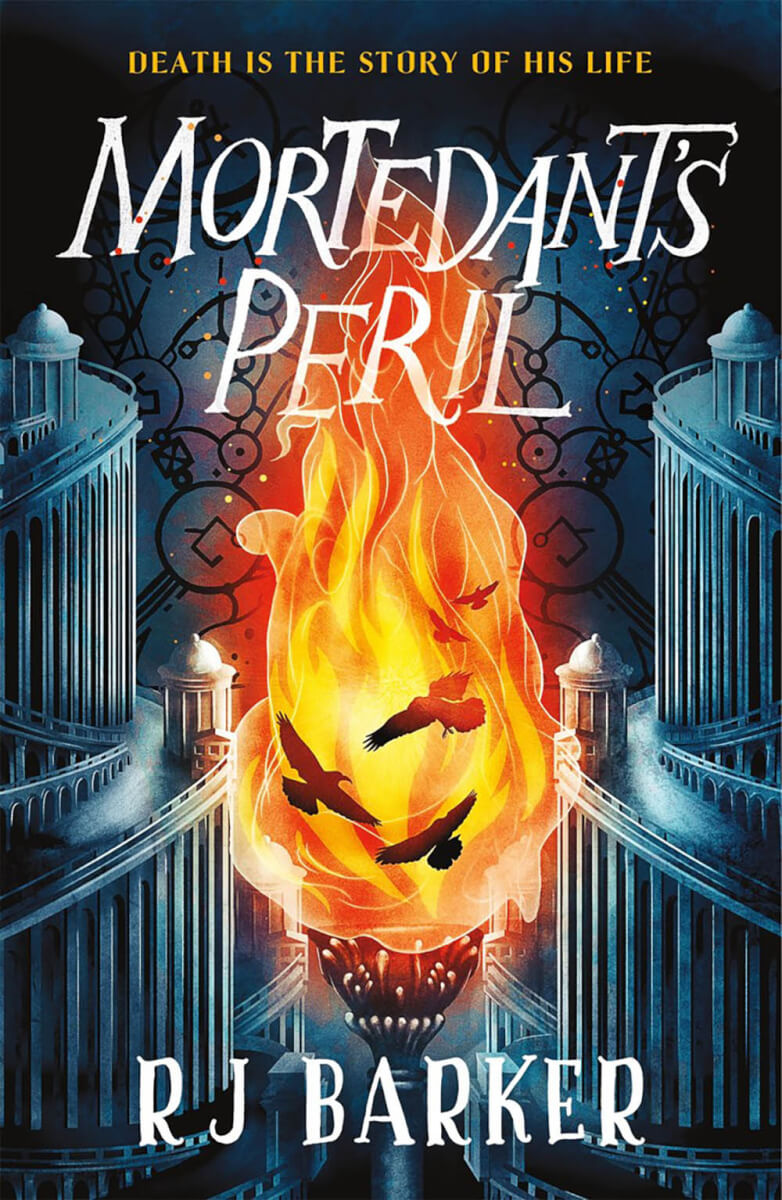
Mortedants can talk to the dead. Sort of. What they can actually do is sift through the bitter miasma of a soul’s confused and terrified last moments, and that’s only if they’re actually good at their job. Mortedant Hasp is good at his job. He is also a misanthropic prick who needs to pay his rent, which is why, against the wishes of his guild, Mortedant reads the soul of a poor actuary whose widow believed he had a fortune squirreled away. But as it turns out, the actuary didn’t have a fortune. He did have a secret. The kind that got him killed, Hasp’s apprentice promptly murdered, and Hasp framed for the death with scant days to clear his name until he is executed on a presumption of guilt. Elbay is a very execution-happy city.
R.J. Barker’s latest work and series starter, Mortedant’s Peril, begins as a detective novel. But it soon morphs into something much darker: gods exist but are either feckless or apocalyptic, and the rigidly hierarchical Elbay is at perpetual war against an encroaching, monstrous wilderness. Throughout, Barker pits Hasp’s prejudices against a range of concerns both supernatural and quotidian, forcing him to confront the essential humanity of beggars, corruptions engendered by myriad kinds of power, and the capricious machinations of the divine. Like all good speculative fiction, Mortedant’s Peril uses its fantastical milieu as an allegorical vehicle, probing the pending concerns of our day. And in this case, Barker wraps his concerns of power and prejudice in a newly trenchant question: What if people, with their pesky needs and inconsistencies, could be replaced? What if there were an artificial alternative to human endeavor? Wouldn’t that be easier?
Barker’s novels are full of people choosing the right thing over the easy thing, often against their own better judgment. His heroes resent their own heroism, examining the myopically selfish priorities of their peers with jealousy, before going ahead and doing their best anyway, because they recognize the stakes. For Hasp, and for Barker, easy is not the same as right, and there is nothing atavistic about insisting that humanity cannot be optimized into obsolescence. Elbay’s survival depends on Hasp and his allies’ intransigent belief that, in fact, people matter. Perhaps, Barker implies, ours does as well.