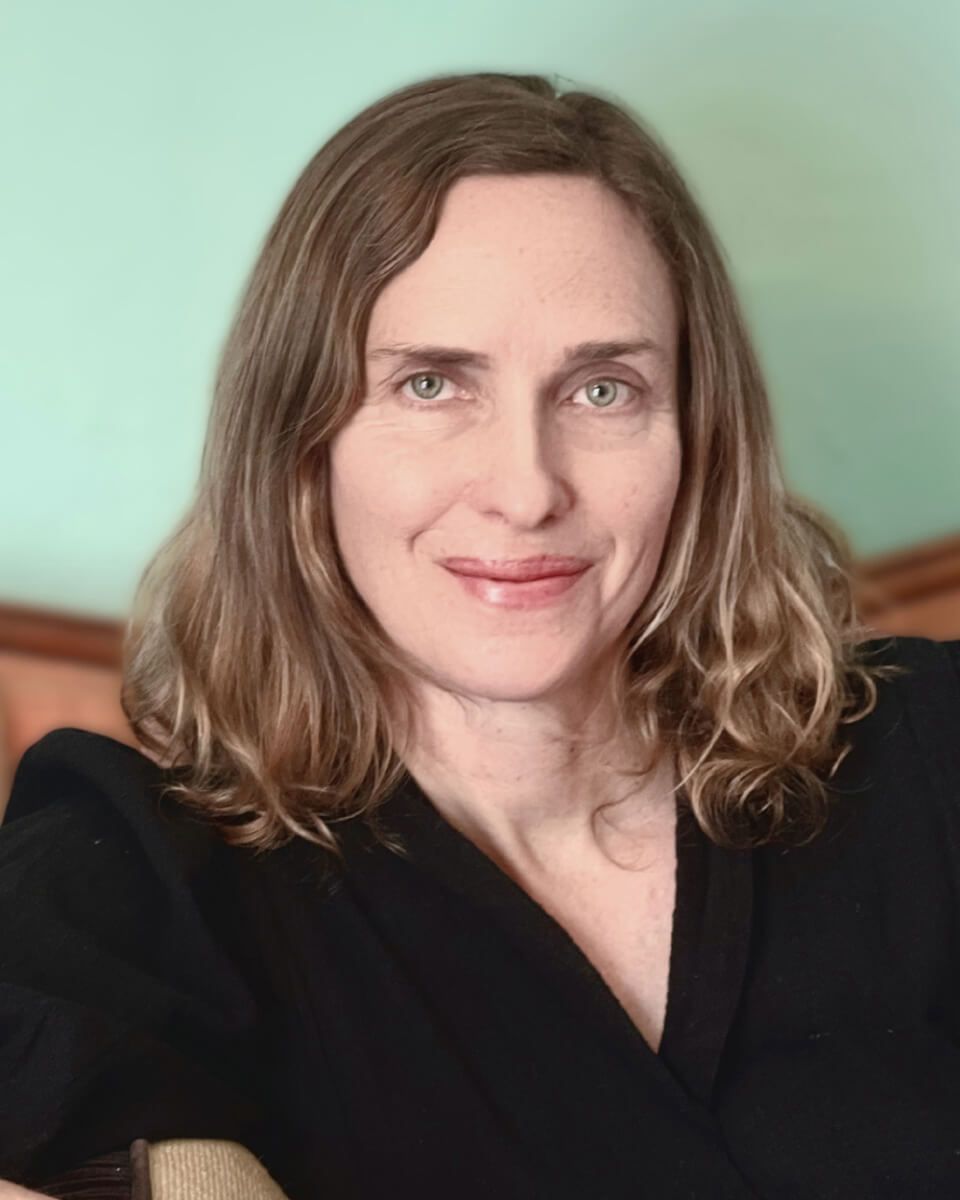
“It’s really hard to get at who Emily Brontë was,” biographer Deborah Lutz remarks, “but also interesting because it is challenging.” In This Dark Night: Emily Brontë, A Life, Lutz approaches the enigma of the “weird, strange, difficult, mysterious person” who created the monumental Wuthering Heights. For Lutz, who is a professor of 19th-century English and American literature at Penn State, this aura of mystery makes Emily the “most fascinating Brontë.” Using recently discovered poetry manuscripts and focusing closely on Emily’s day-to-day life, Lutz creates an unforgettable portrait of a multitalented genius.
The gothic world of Wuthering Heights has its roots in the Yorkshire moors and in the English village of Haworth, where Brontë grew up in a family of gifted siblings, who from childhood wrote and performed plays, poems and stories about invented fantasy worlds they called Gondal and Angria. Lutz’s 2015 book, The Brontë Cabinet: Three Lives in Nine Objects, recreated the lives of three of the siblings—Emily, Charlotte and Anne—through the material objects they made and used, now preserved in the Brontë Parsonage Museum. The miniature manuscripts the siblings wrote and assembled as children, their sewing samplers, walking sticks and lockets of hair evoke their palpable physical existence.
Similarly, in This Dark Night, Lutz wanted to reconstruct the bodily experience of Emily, “how her body felt, what she smelled, what she heard, how cold she was, what kind of clothing she wore, [even] where she went to the bathroom,” she tells BookPage. Lutz’s research thus included walks on the treeless moors surrounding the family’s Haworth home, where the birdsong and fierce wind mirror what Lutz sees as Emily’s “inner wildness.” Lutz thinks of her as a “capital R” Romantic writer, like Lord Byron and William Wordsworth, poets Emily loved who yearned for immersion of the human self in the larger natural world. In Brontë’s case, her love of nature also included observations of how the Industrial Revolution, particularly mining, was altering her beloved moors.
Brontë was “a misanthropic person . . . she didn’t always like other people, and part of that misanthropy comes out in [imagining acts of] sadism.”
The death of her mother and two eldest sisters left Emily and her remaining siblings with irreparable grief that prompted them to seek solace in nature, while also inspiring some of their earliest writings. While Charlotte and her brother Branwell invented fantasy stories of a land called Angria, Emily and Anne created a world called Gondal, where kingdoms rose and fell in violent and shocking ways, reminiscent of A Game of Thrones. The Brontë siblings were incredibly prolific as children, filtering their literary influences through a creative lens all their own. For Emily, this meant that her novel and poems were an amalgamation of the fantasy lands of Gondal and Angria, the poems of Byron and Wordsworth, and gothic novels and stories. The children carefully wrote their stories on scrap paper, which they bound to look like published books. Lutz thinks of the siblings as a “collaborative writing group,” noting that their “writing practices feel very experimental or avant-garde,” which might explain their works’ resulting strangeness and originality.
A chief pleasure of This Dark Night is Lutz’s analysis of the drawings found in Brontë’s notebooks and marginalia, some of which are included in the biography. Her letters, poems and manuscripts are adorned with doodles that hint at the author’s personality. Some of these communicate “humor and lightness”: A silly drawing accompanying a somber poem indicates Brontë’s “refusal to grow up and her resistance to writerly rules.” A sketch of a gnarled tree reinforces her “devotion to the unreclaimed, uncultivated and scarred.” But she also doodled horrific little depictions of violent scenarios: decapitations, bludgeonings, piles of corpses. The gothic novels and stories Emily was reading at the time were redolent with violence, rape, flagellation and other gruesome and unsavory acts. These elements of her imagination emerge in the domestic and sexual violence depicted in her novel. As they say: Wuthering Heights is not a love story.
Read our starred review of ‘This Dark Night’ by Deborah Lutz.
Brontë was not a violent person, but she “wasn’t always the kind of person we would approve of today,” Lutz explains. She was “a misanthropic person . . . she didn’t always like other people, and part of that misanthropy comes out in [imagining acts of] sadism.” She prized solitude and liked dogs more than she liked people. She desired to lose herself in the natural world, as in her poem “I’m happiest when most away,” which imagines her “spirit wandering wide / through infinite immensity.” Lutz notes how many of Brontë’s poems imagine scenes of a lover weeping at the graveside of their beloved, as Heathcliff does over Catherine’s grave. Catherine’s dream of being flung out from heaven onto the heath of Wuthering Heights, where she “woke sobbing for joy,” exemplifies her desire to haunt the Earth. Perhaps, Lutz suggests, Brontë’s vision of an earthly afterlife is a form of grief, a way of finding her own mother’s ghost wandering the moonlit moors. By “excavat[ing] the undergloom,” Lutz writes, Emily penned “her great novel about the heights that owe everything to the lowlands and the dead.”
When I ask Lutz how she feels about Emerald Fennell’s controversial film adaptation of Wuthering Heights, she diplomatically responds, “I’m glad that the movie has caused people to read the novel.” Her own favorite work based on Wuthering Heights comes from Anne Carson, whose 1994 poem “The Glass Essay” reflects on Brontë’s character as a “whacher.” As Lutz explains in This Dark Night, “whacher” was Brontë’s preferred spelling for “watcher,” as in someone who is primarily an observer of life. “Whacher is what she was,” Carson writes. “She whached God and humans and moor wind and open night. / She whached eyes, stars, inside, outside, actual weather.” Lutz’s own close observations of this weird, “whachful” and wonderful Brontë illuminate the author like never before.
Photo of Deborah Lutz © Kris Badertscher