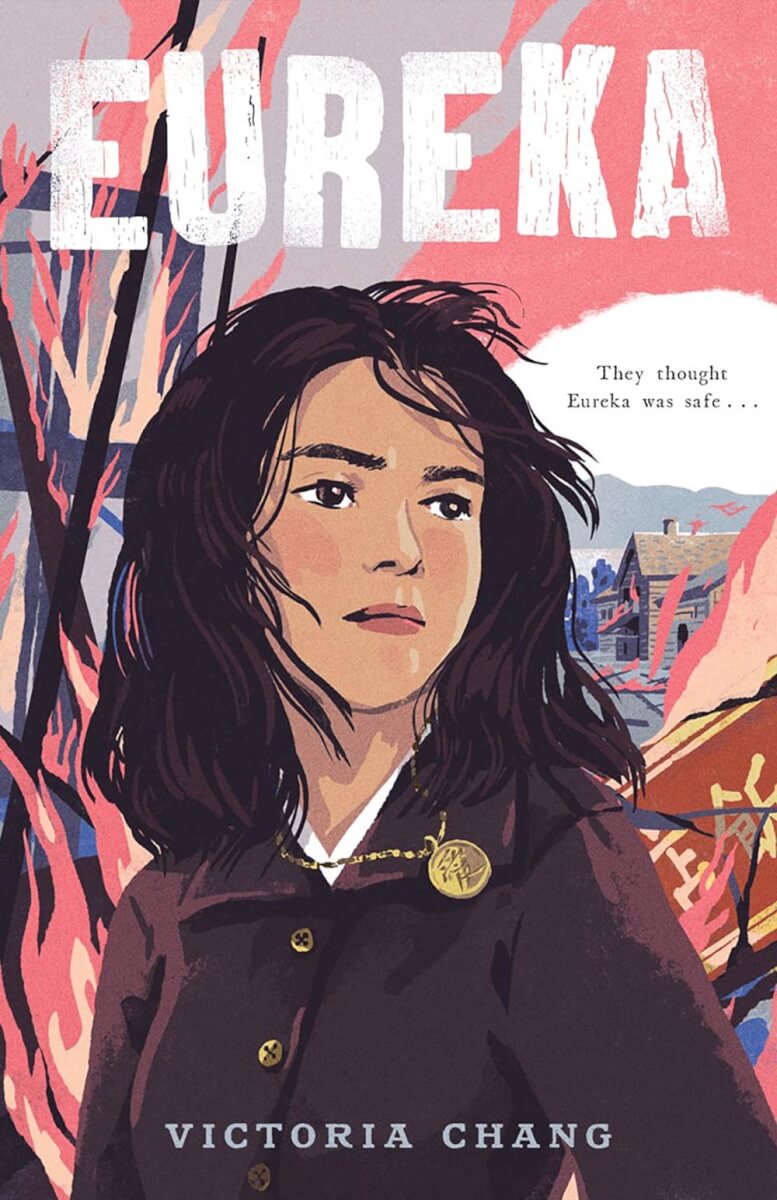
Mei Mei is a curious, loving 12-year-old who lives with her parents in 1884 San Francisco, where they immigrated from Canton, China, in 1875. She’s “not allowed to / go to a public school / in San Francisco / with the American kids,” but attends a school in a church basement with white teachers who cover “math, English, / and a lot about God” as well as a Chinese school.
As award-winning poet Victoria Chang’s lyrical and compelling Eureka opens, Mei Mei’s also helping Ba Ba run the family store; playing hide-and-seek with her best friend Hua Hua; and spending time with Ma Ma. It’s a lovely life, although not without its troubles. Unlike Mei Mei, who can run around “like a free animal,” her mother’s tightly bound “little lotus feet” keep her homebound. And lately, her parents have been lamenting that “San Francisco’s getting / more and more dangerous / for Chinese people.”
When Mei Mei’s parents send her to her aunt in Eureka, 300 miles away, she’s fearful and incredibly sad. But she’ll be able to go to public school there, they reassure her, and be safe from the brokers to whom they still owe money for their 1875 ship’s passage. “Girls like me get sold, / to work,” Mei Mei realizes.
Alas, Mei Mei’s aunt denies her schooling and sends her to the wealthy and unkind Bobbitt family to assist their cook, Mrs. Yu. Mei Mei’s homesickness is tempered by budding friendships with Mrs. Yu and another servant named Tom, as well as Sara Bobbitt’s offer to secretly teach her English. And she’s enthralled by redwood trees “so tall, so black / wearing dusk like a robe.” But her ability to find lightness in dark times falters when racist unrest leads to yet another scary, hurried displacement.
Chang conveys a wide range of emotions—joy, frustration, fear, hope—with skill and style, and she gives Mei Mei’s voice an authentic and compelling mix of innocence and growing world-weariness. Readers will root for Mei Mei as she and her friends bravely struggle toward and ultimately triumph in a conclusion filled with love and hope. Back matter offers further context for this moving, inspiring work of Asian American historical fiction.