Maggie went to bed in Austin, Texas, but woke up in Kair Toren, the setting of her favorite (but sadly unfinished) fantasy series. It’s a world where life is held cheaply and violence abounds, but Maggie almost immediately realizes she can’t be killed when she bounces back from what was most definitely a drowning. A second surprise comes when Maggie sees her actions affecting the plot she knows so well. As she gets to know the 3D versions of her favorite characters, she starts to wonder: Can she prevent the war she knows is coming and save the kingdom?
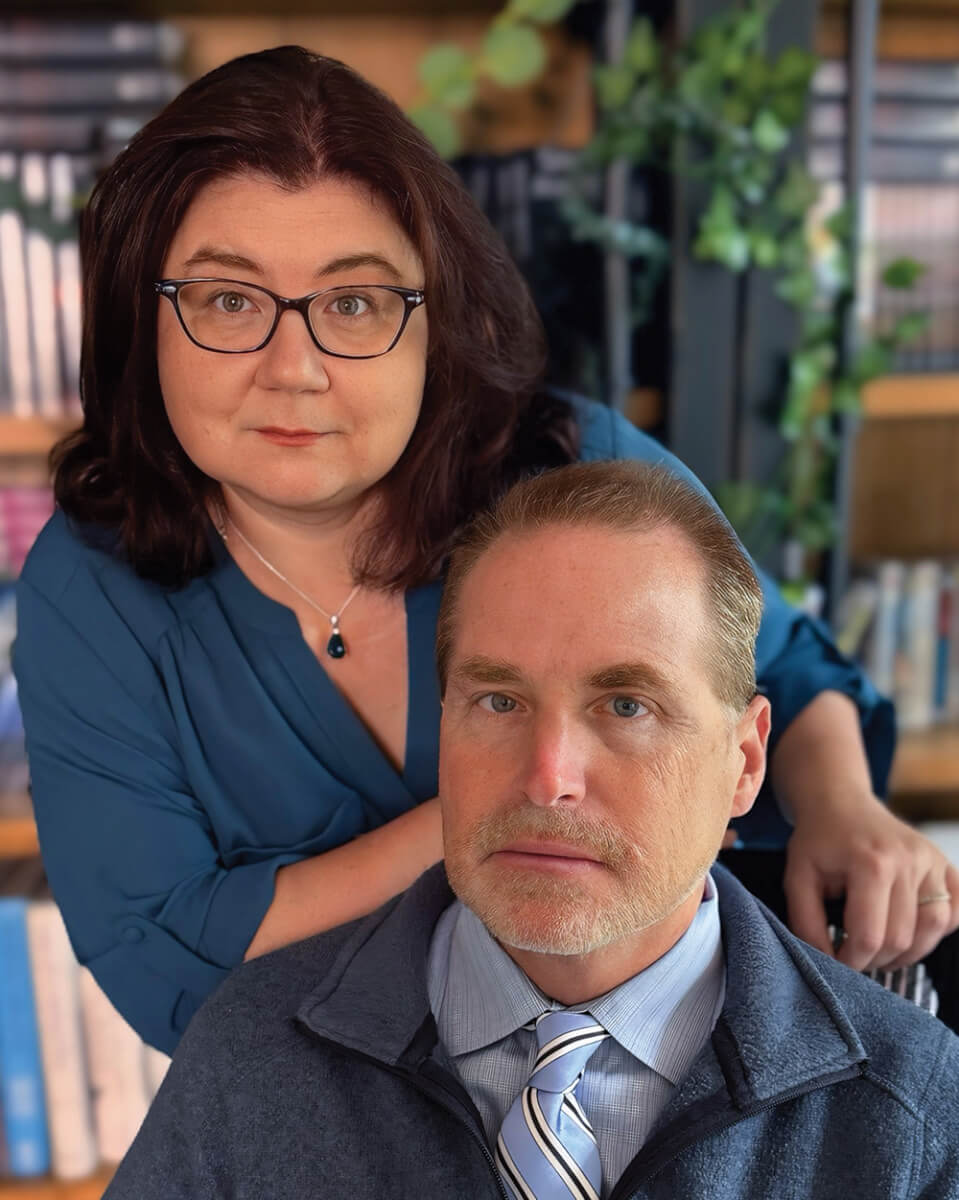
This Kingdom Will Not Kill Me is the first foray into epic fantasy for Ilona Andrews (husband-and-wife team Ilona and Gordon Andrews), and it’s a thrilling take on a book lover’s dream come true . . . even if, or maybe because, the reality is a little more complicated. We asked Andrews, authors of the Kate Daniels series and the Innkeeper novels, about how it feels to change genres and how fan culture affects writers.
Starting a new series from a beloved author is always exciting as a reader. How does it feel as authors to step into a new world?
Honestly, exciting and scary. It’s a lot of fun to play in Maggie’s world. Exciting, because everything is new, and we’re making it all up as we go along. It can be anything we want it to be. Scary because while we had fun writing it, we’re not sure how our readers, new and returning, will feel about it. It’s different, but hopefully good different.
Fans of your work (like the Kate Daniels series) know you primarily for urban fantasy. What drew you to a high fantasy setting?
Nobody knows this, but the first couple of books we wrote were epic fantasies. They are awful, and they will never see the light of day. We stumbled onto Kate’s story and urban fantasy by accident. The genre was getting very popular at the time, and we read some of it. One day, Kate’s voice just kind of appeared, and because the urban fantasy genre was so prevalent, that was the story that sold and started our career. With This Kingdom Will Not Kill Me, we never aimed for high or epic fantasy. In fact, it began as a slice-of-life portal fantasy and was much smaller in scope. It just so happened that Maggie loved all the things about fantasy worlds that we loved. Her journey through the world of Rellas truly took on a life of its own.
The stories of Kair Toren are so close to Maggie’s heart. What do you think kept her intrigued for all these years?
All of us have a book or series that we return to year after year. We all have different reasons for doing so. For Maggie, The Rise of Kair Toren became a comfort read. She has grown, over the years, to care about the characters. Some of them became friends, others enemies. She knows their secrets. Their thoughts. Their inner wishes. They became real to her long before she found herself in Kair Toren. That’s why she can’t just abandon them to their fate.
Maggie knows a lot about Kair Toren, but her information can be incomplete, and occasionally it’s wrong. How did you keep track of what was canon for Maggie’s in-universe books versus what was true of the world she was actually in?
With character descriptions. For instance, if a book is made into a show or movie, we argue over the casting. The lead is all wrong. That’s not how they look. What we mean when we say that is, that isn’t how we pictured them in our head. When we read, our minds fill in the blanks. We make assumptions, some of them incorrect, and these assumptions can be remarkably persistent.
Also, it cannot be overstated that what Maggie read was an author’s account of a fictional realm. What she woke up in is a living, breathing world. Just by being in that world, she’s changing it. Essentially, the longer she stays and tries to fix things, the more the future changes. She is painfully aware of that.
“Essentially, the longer she stays and tries to fix things, the more the future changes.”
I love Maggie’s balance of compassion and fierce determination. How do you find that narrative balance between the small moments with the found family she’s cobbling together and the kingdom-shattering plots she’s trying to unravel?
They are interconnected. So often we forget that events and policy-changing decisions that seem broad and distant at first glance can end up affecting us on a very intimate, immediate level. Every shift of the timeline has consequences, and she is watching them play out in real time. It’s those small moments that demonstrate the true impact of everything she does.
But at the same time, people are resilient, and even when the world is burning, we have to go on with our lives. We still cook food, crack jokes and complain about random small inconveniences. The world wouldn’t feel alive without that texture, and we love writing it.
You’ve been releasing serialized novels for more than a decade alongside your traditionally published books. Has writing serialized stories affected how you approach writing overall? How do you work together as a writing duo?
When we’re writing a regular book or novella, we tend to write toward our word count. We try to get 2K or more per day, and usually aim to finish a scene or two, but we may stop in the middle of the action if we are too tired.
When the story is serialized, we think and write in scenes or chapters regardless of word count. The story tends to be more episodic, and each installment usually needs to end on a hook to keep the readers engaged. Serialized stories also tend to be smaller in scope and have a smaller cast. Reading in weekly installments means that the readers may not retain information quite as well as when they are powering through the narrative in a single sitting.
As far as writing together, we sit side by side, and one of us dictates while the other types. Everything that makes it into publication is a collaborative compromise between the two of us.
“Every shift of the timeline has consequences, and she is watching them play out in real time.”
This book deals with fan culture and online fandoms, as Kair Toren fans speculate on the future of the unfinished series. How do you think fan culture affects how we interact with media (whether for good or ill)?
Reading is a unique form of entertainment because it is a creative endeavor on both sides. The authors write the story, but the readers add their imagination and creativity when they read it.
That dynamic has always been a thing, and the relationship between the readers and books has remained the same. What we feel has changed is the relationship between authors and readers. Prior to the internet, the only way to interact with your favorite author, besides attending a signing, was to write a letter. They might get your message, they might even respond, but it was by no means a guarantee and there was usually a significant delay.
It’s much quicker to fire off an email or leave a comment on a blog or on a social site. That ease of communication has created expectations of access and engagement, and the collective voices of the fans can be very loud. What the fans want and what the story needs don’t always align.
As far as unfinished series go, books are not widgets. Sometimes the inspiration is not there, and once you emotionally disconnect from a story, trying to write is monumentally difficult. Maggie sees the reader side of it, with all the associated frustrations, but being on the author side is equally upsetting. Sadly, for Maggie, rather than comfortably reading the third book in her cozy apartment, she’s going to be a part of it.
Novels like this invite us to wonder about what it might be like to slip into a story we know well. Are there any of your own worlds you’d be tempted to visit?
Kate is too post-apocalyptic and scary. Hidden Legacy would be great if we were ridiculously wealthy Primes, but as just ourselves it wouldn’t be very fun.
We would love to be Innkeepers. Maybe an Innkeeper and her favorite grumpy werewolf. They may be the most like us but in a world with vampires, space orcs and, most importantly, Costco.
What’s next for you?
We are finishing a novella set in the Hidden Legacy universe. We’re, hopefully, more than halfway through the next Maggie book. It is very absorbing and fun to write. After we finish, we will go on a short book tour to celebrate the publication of This Kingdom Will Not Kill Me. After that, maybe a short vacation. We need one desperately.