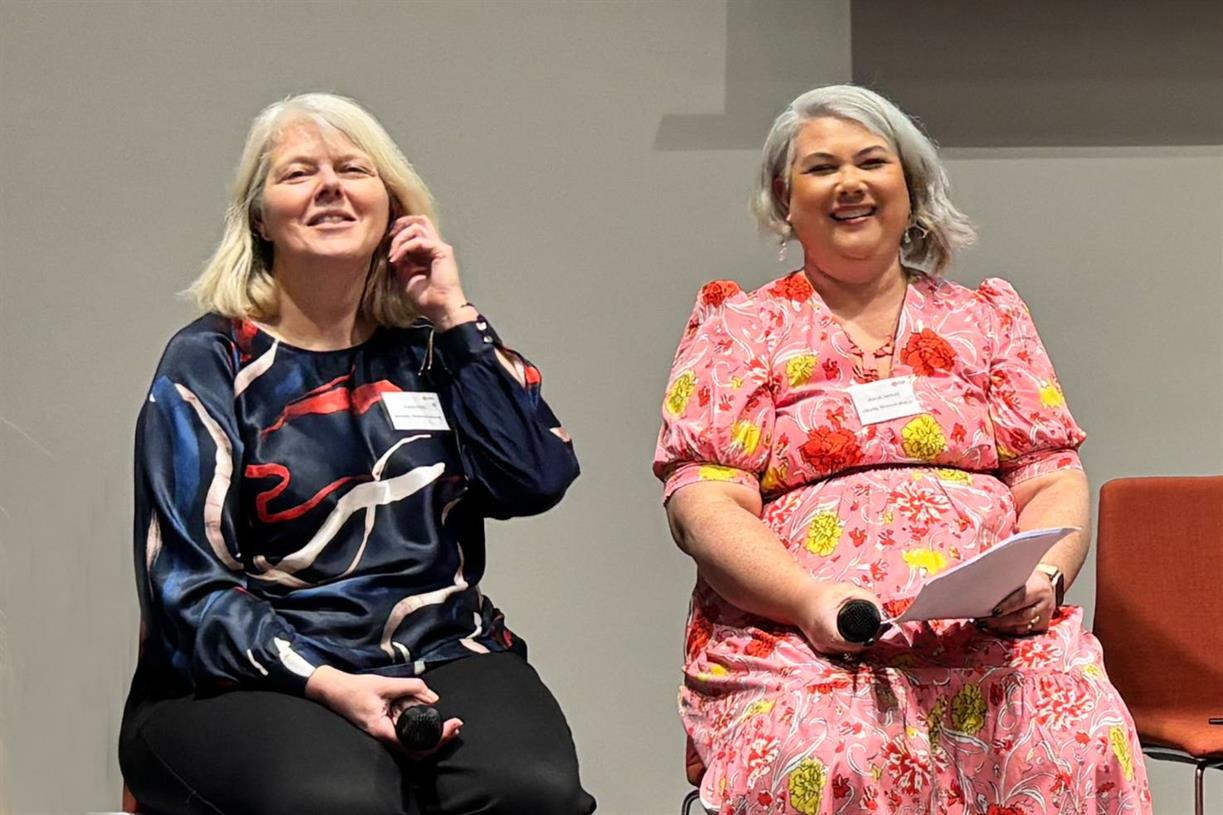
Trust and communication are the key to successful co-leadership, the joint chief executives of the Charity Finance Group have said.
Sarah Lomax and Clare Mills were speaking at an event yesterday hosted by the consultancy Good Innovation, held for the launch of its Navigating Uncertainty: Lessons from Nature report.
The pair were appointed co-chief executives of the charity in October, with the infrastructure body’s former chief, Caron Bradshaw, moving to a new part-time role as growth and sector solutions lead.
Lomax told delegates at the event: “For me, the bottom line is trust and communication. If you have those two things, I don’t see why it couldn’t work, even in a larger organisation.”
She said she viewed co-leadership as a “really feminist model of leadership”, because it “goes against the patriarchal model” of there being a single chief executive at an organisation’s helm.
“Two heads are better than one. We can go further a lot faster, we can drive the organisation forward faster.”
Lomax also told delegates that co-leadership “goes a long way to alleviate” the symptoms of burnout because it prevents feelings of isolation.
The duo said that one of the CFG’s core values was “dynamism”, which Mills said was “about finding innovative ways to do things, trying things that are different, trying to shake up existing power structures and models of governance”.
She said: “If we don’t innovate as a sector, as organisations and as people, we stagnate. And if we stagnate, we start to lose our ability to grow, learn and thrive.”
Mills and Lomax’s co-leadership work began prior to their chief executive appointments, when they became deputy co-chief executives in April 2024.
From that stage, they put in place daily communication plans with each other, Lomax said, which involved daily check-ins at the end of each day, a practice they have continued.
They also developed a co-leadership document for themselves and for the charity’s board prior to taking on the co-chief executive role, which also included an “exit strategy”.
Mills said this was important to them because often, leaders will get “caught up” in their roles and not do other things with their lives that they may have wanted to.
“I’m 10 years older than Sarah, and I’d like to retire at some point,” Mills said. “So we needed to work on an exit strategy.
The leaders said this was beneficial for their own peace of mind, but also for their board, with Lomax saying it meant the board “wasn’t signing up for [a co-leadership structure] in perpetuity”.
Lomax said they also divided responsibilities early on and held discussions about how decision-making would work.
“Any huge, fundamental decisions we are obviously going to take as a joint one. But smaller, day-to-day decisions are made by whoever is around. And we have fully pre-agreed to support one another.”
She added: “We are very much a team and present a united front. It’s super-important not to have factions and to discuss any issues we might have privately.”
Lomax added that the pair “bring very complimentary strengths and skills” to their roles, meaning they can be “very supportive and learn from each other as well”.
MIlls said this has helped with organisational resilience too, saying: “If one of us, for whatever reason, was no longer around, we’ve not got a vacuum at the top.
“We’re learning from each other all the time,” Mills said. “And we’ve actually taken on different bits of the organisation to help us grow that knowledge, rather than sticking exclusively in our lane.”