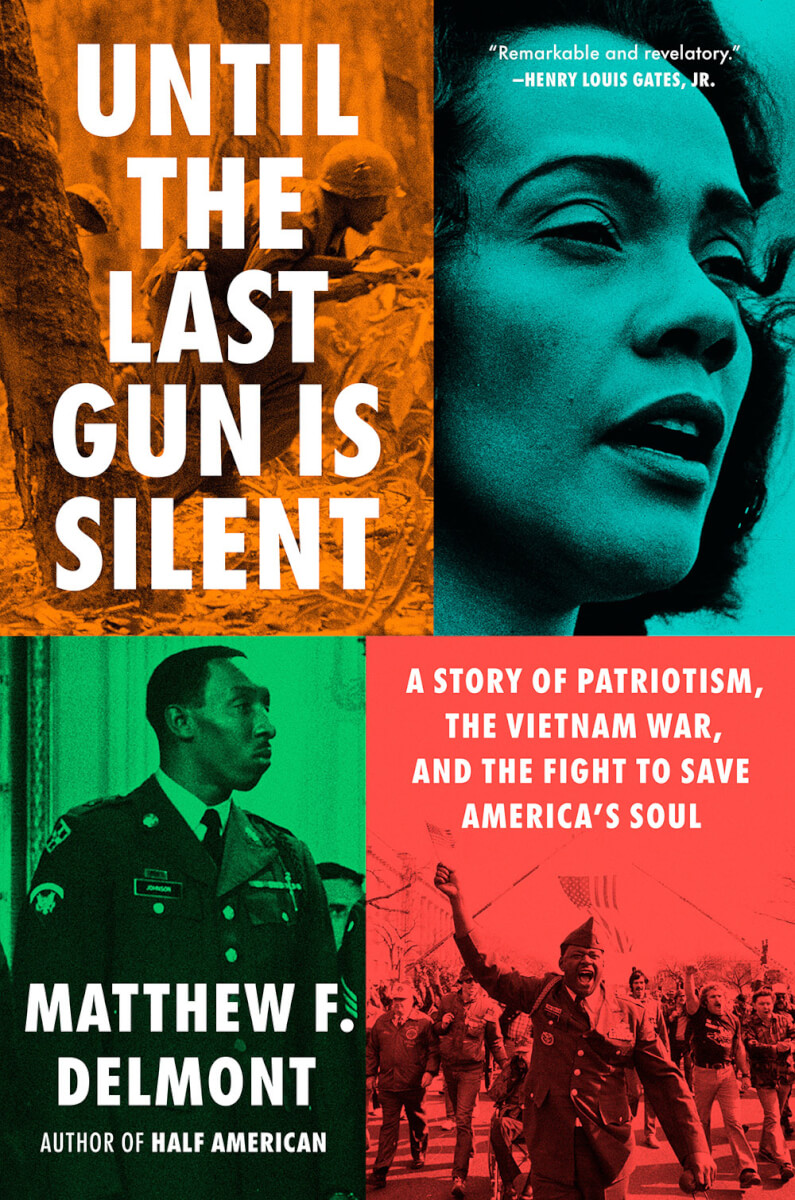
Throughout the 1960s and somewhat beyond, two subjects dominated national news coverage: the Civil Rights Movement and the Vietnam War. For most, they were separate issues. Some saw it differently, especially young Black men of draft age and their families. In his meticulously researched and beautifully written Until the Last Gun Is Silent: A Story of Patriotism, the Vietnam War, and the Fight to Save America’s Soul, award-winning historian Matthew F. Delmont explores that period in rich detail through the lives of two people keenly aware of the close relationship between the war and civil rights: activist Coretta Scott King and Dwight “Skip” Johnson, a Black soldier from Detroit.
Johnson was one of the more than 300,000 Black Americans sent to war, a bright, 19-year-old Detroiter who reported to serve when his draft notice came in 1966. Just over a year later, he fought his way out of an ambush and saved the lives of many other soldiers, earning himself the Medal of Honor. Once home, he became a husband and father and worked as an Army recruiter, but troubles plagued him. Psychological and physical illness, financial crisis, the military’s failure to advance his career and a growing sense of guilt culminated in tragedy.
Delmont captures the period vividly and expertly from many perspectives. In Washington, defense secretary Robert McNamara surmised they were fighting the war on poverty by giving young Black soldiers jobs, and the experience might “ ‘cure them of the idleness, ignorance, and apathy’ that defined their lives.” In reality, as Delmont shows, Black troops serving in Vietnam had a “growing unease that they were being used as cannon fodder.”
Ably tracking the different ways that civil rights groups reacted to the war, Delmont reveals Coretta Scott King to be a fierce and visionary leader who spoke against the U.S. entering the conflict earlier and more forcefully than her husband. Indeed, Delmont positions Coretta as the key to Martin Luther King Jr.’s evolution as a leader, pointing to the Reverend’s 1967 “Beyond Vietnam” speech as a watershed moment. In it, King condemned the irony of watching Black and white boys kill and die together in Vietnam, when they could not attend the same schools at home. This “sweeping, unflinching indictment of U.S. foreign policy,” writes Delmont, was a turning point in King’s activism that he “would not have reached without Coretta’s influence.” After King’s death, Coretta continued to build bridges between the Civil Rights and global peace movements and hold politicians accountable when they rushed into military conflicts.
By unspooling Johnson’s story alongside that of the Kings, Delmont memorably illustrates the tensions of the era. With masterful storytelling and graceful prose, Until the Last Gun Is Silent will force readers to reckon with how domestic racism and foreign military conflict are intertwined.